Explore freely · No account needed · Sound is optional
A god. A city. A gathering storm.
When rain meant renewal.
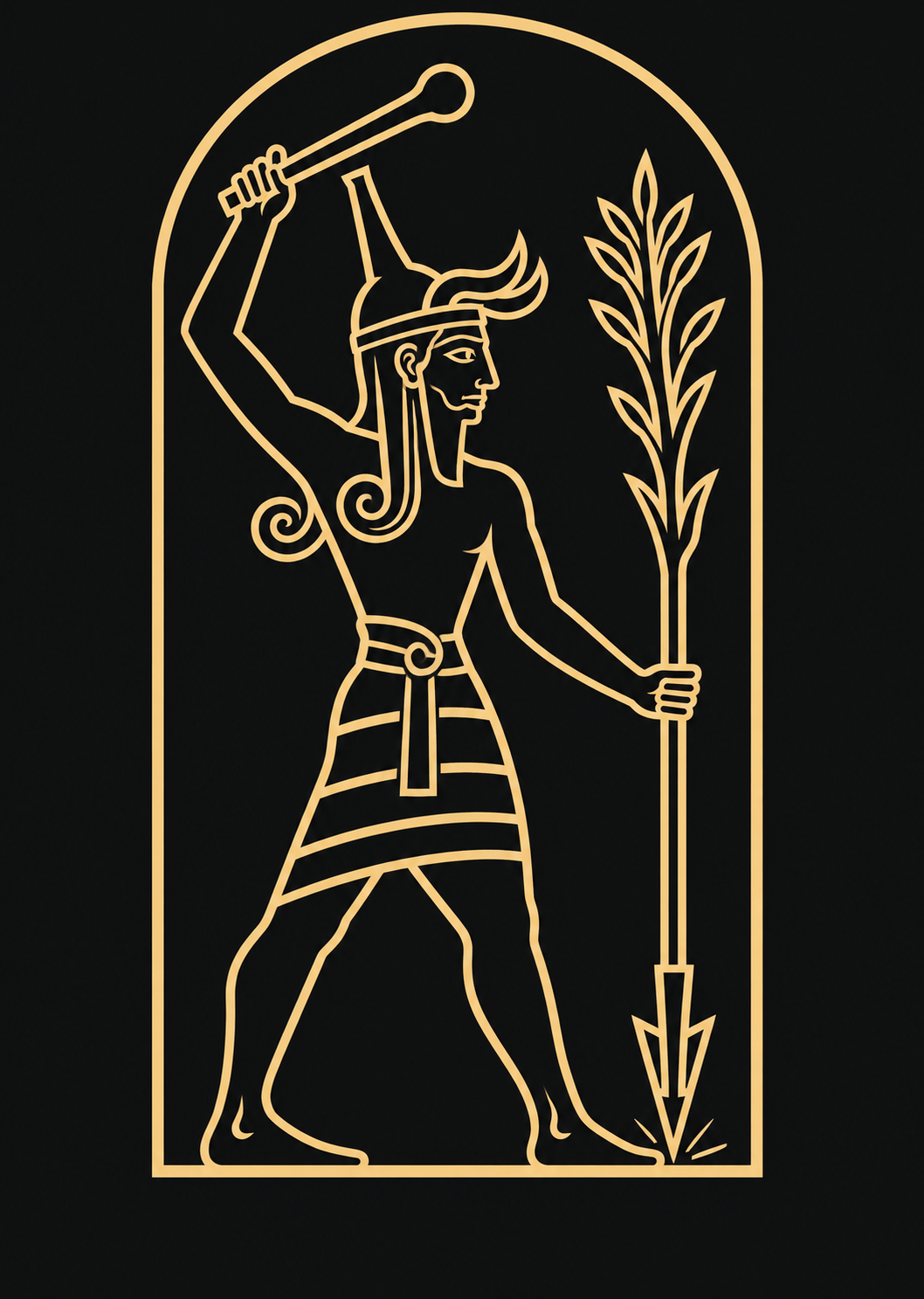
Baal was a powerful storm god worshipped at Ugarit, on the coast of what is now Syria. His rain sustained the fields and the people who depended on them. He belonged to a world of many deities, including El, Athirat, and Anat.
His name is more precisely transliterated Baʿal, with ʿ representing the consonant ayin; this site uses the familiar spelling Baal in general text.
“Baal” means “lord.” The title appears in different places and traditions. This experience focuses on the storm deity commonly called Baal Hadad and the evidence from Late Bronze Age Ugarit, rather than combining every later tradition associated with that name.
The city’s clay tablets preserve myths, offerings, and ritual prescriptions. Its excavated sanctuaries and artworks give us further glimpses of religious life. Together they offer a starting point, but not a complete script for a ceremony.
KTU abbreviates Die keilalphabetischen Texte aus Ugarit (The alphabetic cuneiform texts from Ugarit), a scholarly catalogue. References such as KTU 1.119 identify a text in that catalogue, not a date; line numbers identify passages within it.
A ram for Baal appears in KTU 1.39, line 6. KTU 1.119, lines 20′–22′, lists birds, a liver, and a ram as a burnt offering to Baal of Ugarit. Later in that text, lines 26′–36′, a threatened city promises a bull to Baal in a plea for protection. These are distinct textual contexts, not one universal ceremony.
The exterior and courtyard follow the volumetric reconstruction credited to Olivier Callot in the supplied archaeological illustration: a low entrance vestibule before a tall sanctuary, approached by stairs through an enclosed courtyard. The reconstructed upper levels and roof terrace interpret the surviving plan and massive masonry; they are not preserved intact.
Journey across the ancient Mediterranean through future temple experiences and explorations of belief. Each place has its own history, deities, and surviving evidence.
01 / SICILY
Motya
Baal & the sacred pool
An island sanctuary where temples, water, and the night sky offer a new way into the Phoenician world.
Coming soon
02 / TUNISIA
Carthage
Baal Hammon & Tanit
Discover Punic devotion through dedication stones, inscriptions, and the vows preserved in a great Mediterranean city.
Coming soon
03 / SYRIA
Palmyra
The sanctuary of Baalshamin
Enter the story of an oasis sanctuary, monumental columns, and the meeting of traditions along caravan routes.
Coming soon
04 / ANCIENT ISRAEL
Samaria
Baal & the royal city
Explore the temple described in the biblical account of Ahab, royal patronage, and the limits of reconstructing a lost sanctuary.
Coming soon
JERUSALEM · FIRST TEMPLE PERIOD
Jerusalem: Baal Worship & Reform
Coming soon
The evidence for the worship of Baal in ancient Jerusalem comes primarily from two complementary categories: biblical textual sources and archaeological/epigraphic data.
Explore the evidence for Baal worship in Jerusalem
While the Hebrew Bible explicitly describes periodic state sponsorship and popular veneration of Baal in Jerusalem, the material record reveals a broader, syncretistic Canaanite-Judean religious landscape, marked by a contrast between pervasive folk cult items and overwhelmingly Yahwistic official epigraphy.
1. Biblical Textual Evidence
The biblical narrative records several distinct waves where the cult of Baal entered Jerusalem’s civic and domestic life:
The Omride Influence & Athaliah (9th Century BCE): Following the political alliance between Judah and the northern Kingdom of Israel, Queen Athaliah (daughter or sister of Ahab) ruled in Jerusalem. Second Kings 11:18 explicitly notes that after her overthrow, the populace “went to the house of Baal and tore it down; his altars and his images they broke in pieces, and they killed Mattan the priest of Baal before the altars.” This indicates an actual institutional temple dedicated to Baal stood in or near Jerusalem.
Ahaz and Manasseh (8th–7th Centuries BCE):
Ahaz is criticized for making cast metal images for the Baals and burning offerings in the Valley of Hinnom (2 Chronicles 28:2–3).
King Manasseh rebuilt bamot (high places), erected altars for Baal, and introduced ritual vessels into the Temple complex itself (2 Kings 21:3).
The Reforms of Josiah (Late 7th Century BCE): Second Kings 23:4–5 details Josiah’s purge, ordering the high priest to remove from the Temple of Yahweh all vessels made for “Baal, Asherah, and all the host of heaven,” burning them outside Jerusalem in the fields of the Kidron Valley.
Prophetic Critique (Jeremiah & Zephaniah): Writing in late pre-exilic Jerusalem, Jeremiah condemns residents for burning incense to Baal on the flat roofs of their houses (Jeremiah 32:29) and building the high places of Baal in the Valley of Ben-Hinnom to sacrifice children (Jeremiah 19:5, 32:35). Zephaniah 1:4 speaks of cutting off “every remnant of Baal” from Jerusalem.
2. Archaeological & Material Evidence
Direct epigraphic dedications naming the god Baal in Jerusalem are sparse, largely because royal administrative seals heavily favored Yahwistic names, and the city underwent repeated destructions and rebuilds. However, material culture reflects significant Canaanite storm-god and fertility syncretism:
Iconographic Seals and Scarabs: Excavations in the City of David have yielded Iron Age scarabs and stamp seals depicting Levantine storm-god motifs. Notably, scarab seals dating from the Iron I / early Iron II transition (ca. 10th–9th centuries BCE) depict the classical Levantine “smiting god” posture—traditionally associated with Baal/Hadad or Baal-Seth wielding a mace or thunderbolt.
Judean Pillar Figurines (JPFs): Unearthed in huge numbers across late Iron II Jerusalem (particularly the City of David and the Ophel), these clay female terracotta figurines reflect widespread domestic cult practice. While most commonly associated with Asherah or general fertility, they demonstrate that popular religion in pre-exilic Jerusalem was thoroughly polytheistic/syncretic rather than strictly monotheistic, fitting the prophetic descriptions of household shrines.
Tophet Cult in the Valley of Hinnom: Archaeological surveys of the Hinnom and Kidron valleys locate the deep ravines where biblical texts place the Tophet, an open-air installation linked to illicit offerings to Baal and Molek. While early agricultural terraces and later Byzantine/Roman quarrying have obscured pre-exilic ritual strata, the topography matches the extramural cult sites targeted by Josiah’s desecration efforts.
3. Epigraphy and Onomastics (Name Evidence)
An indirect measure of divine veneration in ancient Israel and Judah is onomastics—the presence of divine names (theophoric elements) within personal names found on ostraca, seals, and bullae:
Category
Frequency in Jerusalem / Judah
Scholarly Significance
Yahwistic Names (-yah, -yahu)
Over 85–90% of late Iron Age seals and bullae.
Confirms that Yahweh was the official national and administrative deity of Judah.
Baal Theophoric Names (-baal)
Rare in Judah; occasional occurrences in early monarchic records (e.g., Jerubbaal, Eshbaal, Beeliada).
By the 8th–7th centuries BCE, the title Baal (“lord” / “master”) had either fallen out of favor due to polemics or had its theophoric use replaced/assimilated into Yahwistic titles.
The combined evidence indicates that while Baal worship in Jerusalem rarely eclipsed Yahweh as the chief national patron in official state archives, it operated as a persistent syncretistic cult—alternating between state-sponsored foreign shrines (under Athaliah and Manasseh) and extramural/domestic folk veneration until the late 7th-century BCE reforms.
Future experiences will distinguish archaeological evidence, ancient texts, and modern interpretation. Baal Hammon, Baalshamin, and Baal-Hadad will retain their distinct identities.
“Rider of the Clouds” translates the attested Ugaritic epithet rkb ʿrpt, also rendered “Rider on the Clouds.” It evokes Baal’s rain-bringing power and his role as a divine warrior.
The heading combines bʿl (Baal), hd (Haddu, the Ugaritic form commonly rendered Hadad), and that epithet. This is a modern arrangement of ancient names and an attested title, not a quotation of one complete ancient inscription. The sign 𐎟 separates words.
Ugaritic writing is appropriate for an experience set around 1250 BCE. Ugarit is the city; Ugaritic is the local language and the name commonly used for its 30-sign alphabetic cuneiform script. It was used in the thirteenth century BCE to record local texts, including myths.
The building conventionally called the “House of the High Priest,” near the temples, yielded Baal Cycle tablets and bronze objects bearing Ugaritic dedications.
The date 1250 BCE is an approximate setting, not a verified date for every text or ritual referenced here. The ceremony’s English prayers are modern compositions, not translations of surviving Ugaritic prayers. Our digital souvenir is also a modern creation.
A ram for Baal appears in KTU 1.39, line 6. KTU 1.119, lines 20′–22′, lists birds, a liver, and a ram as a burnt offering to Baal of Ugarit. Later in that text, lines 26′–36′, a threatened city promises a bull to Baal in a plea for protection. These are distinct textual contexts, not one universal ceremony.
Pierre Bordreuil and Dennis Pardee, A Manual of Ugaritic (2009), ritual text 8, translates KTU 1.39 / RS 1.001, including a ram for Baal. Dennis Pardee, Ritual and Cult at Ugarit (2002), is a central scholarly study of the ritual corpus. KTU numbers identify texts, not dates.
The interpretation of the “firstborn” in KTU 1.119 is disputed and may refer to an animal. This experience does not present human sacrifice as an established routine of Baal Hadad’s worship at Ugarit. Later evidence from other places cannot simply be transferred to this setting.